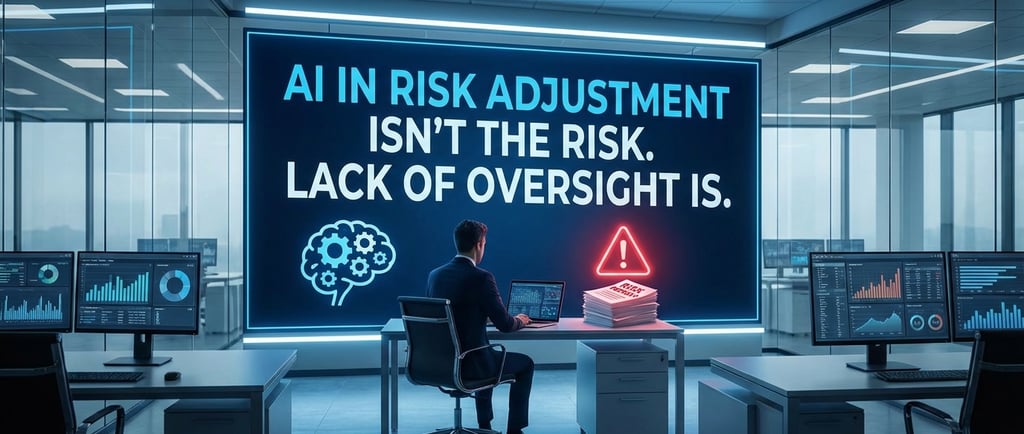
AI in Risk Adjustment Isn’t the Risk. Lack of Oversight Is
As AI becomes more integrated into risk adjustment and revenue cycle operations, many healthcare organizations overlook a critical factor: governance. This article breaks down how AI can introduce compliance risk, unsupported diagnoses, and audit exposure, and why oversight is essential to protect revenue integrity.
Lavette Minn
3/28/20262 min read
Healthcare organizations are moving quickly to integrate artificial intelligence into risk adjustment and revenue cycle operations.
The promise is clear.
Faster chart reviews.
Improved efficiency.
More data processed in less time.
But there is a critical gap in how this transformation is being approached.
The focus is on adoption.
The risk is in the lack of oversight.
The Real Issue Isn’t AI
AI is not inherently the problem.
In fact, when used correctly, it can support coding teams by identifying patterns, surfacing potential diagnoses, and improving workflow efficiency.
The issue arises when organizations assume that automation equals accuracy.
It doesn’t.
AI can suggest a diagnosis.
It cannot validate whether that diagnosis is fully supported by clinical documentation.
That responsibility still belongs to the organization.
How Risk Is Being Introduced
When AI is integrated into coding workflows without proper governance, several risks begin to emerge:
💎 Unsupported diagnoses being captured based on incomplete or misinterpreted documentation
💎 Overreliance on AI outputs without human validation
💎 Inconsistent coding practices across teams and systems
💎 Increased exposure during RADV audits
These issues do not remain isolated.
They scale across providers, encounters, and populations.
And when they scale, they become financial and compliance risks.
The False Sense of Security
One of the most dangerous assumptions organizations make is that AI reduces risk.
In reality, it can amplify existing weaknesses.
If documentation practices are inconsistent, AI will reflect that inconsistency.
If coding validation processes are weak, AI will accelerate those gaps.
AI does not correct flawed systems.
It exposes them.
Where Compliance Comes In
Risk adjustment is not just an operational function.
It is a compliance-driven process tied directly to reimbursement.
Every diagnosis submitted must be:
• supported by documentation
• aligned with coding guidelines
• defensible under audit
If AI-generated or AI-assisted diagnoses do not meet these standards, organizations may face:
💎 Overpayments
💎 Audit findings
💎 Regulatory scrutiny
💎 Financial recoupments
The Role of Human Oversight
AI should never replace professional judgment.
Certified coders and compliance professionals play a critical role in:
💎 Validating diagnoses using MEAT criteria
💎 Interpreting clinical documentation
💎 Ensuring coding accuracy and consistency
💎 Maintaining compliance with CMS guidelines
AI can assist.
But it cannot assume accountability.
What Organizations Should Be Asking
Instead of asking:
“How can we implement AI faster?”
Healthcare leaders should be asking:
💎 How are AI-generated diagnoses being validated?
💎 What controls are in place to prevent unsupported coding?
💎 Can our coding practices withstand an audit?
💎 Do we have governance over AI-assisted workflows?
These questions shift the focus from efficiency to accountability.
The Path Forward
AI has a place in healthcare.
But it must be implemented with structure.
That includes:
💎 Clear validation processes
💎 Strong documentation standards
💎 Ongoing audit and review
💎 Defined governance frameworks
Without these controls, AI becomes a liability—not a solution.
Final Thought
AI is not a cleanup tool.
It is an accelerator.
If your processes are strong, it will strengthen them.
If your controls are weak, it will expose them.
Because in healthcare:
Every diagnosis must be supported.
Every decision must be defensible.
And every dollar must be justified.
LETS CONNECT
Strengthening healthcare organizations through compliance, revenue integrity, and coding accuracy.
contact me
stay in the loop
info@lavetteminn.com
800-687-7812 ext 1000
© 2026. All rights reserved. Designed by Blue Diamond Brandz